
Avoidant Attachment: What It Is and How to Actually Heal It
At first, it’s important to note that attachment styles are not fixed identities. You are not “an avoidant person.” We all develop adaptations that later turn into patterns but they don’t define who we are. And it’s not uncommon for adaptive patterns around attachment to show up in different ways. You might notice avoidant patterns in one relationship and feel much more secure in another. And while you may have a default attachment style, these patterns can still change, and most importantly, they can be healed.
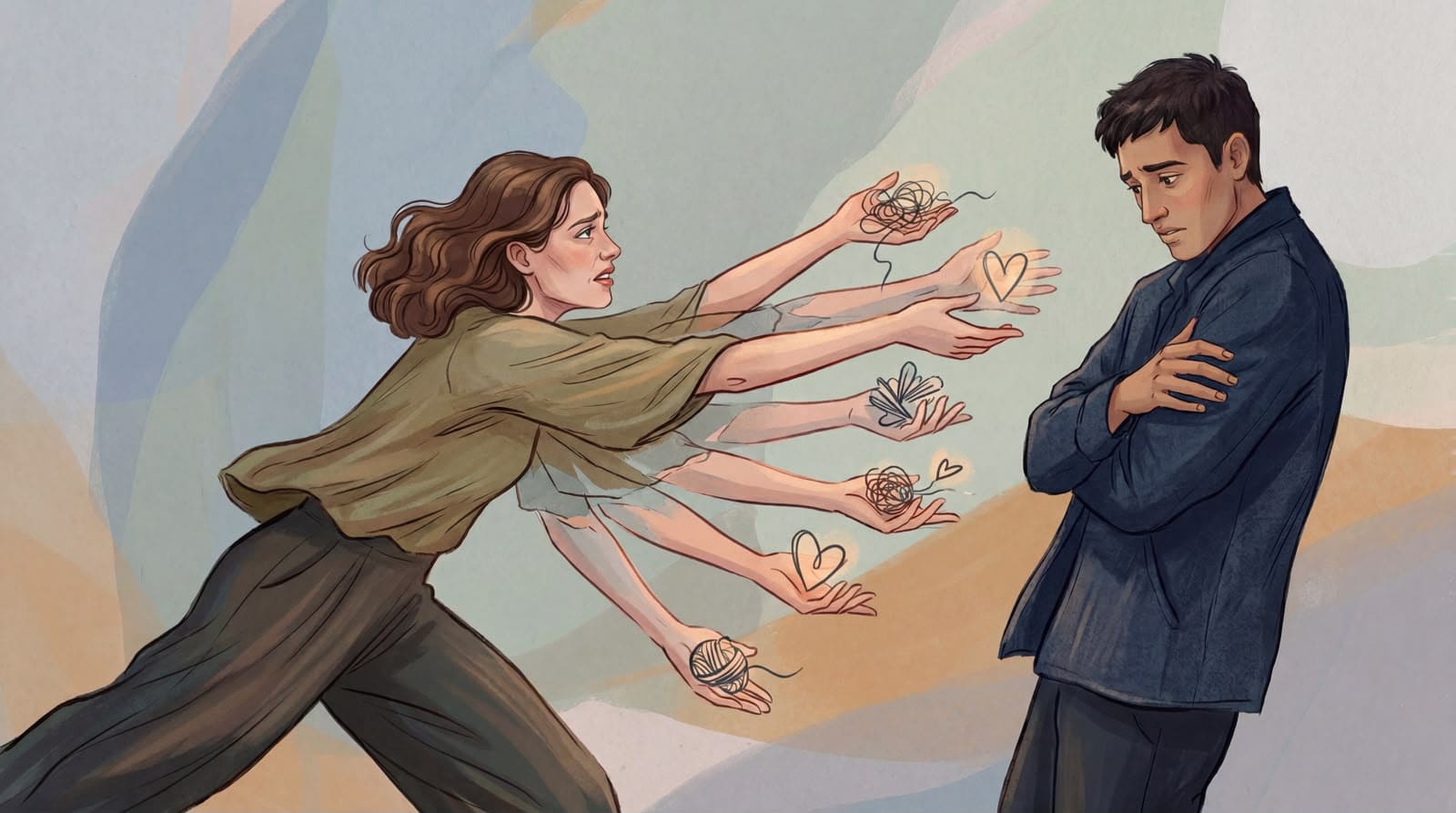
For someone with avoidant attachment, connection can feel desirable and threatening at the same time. You might genuinely want connection but have an unconscious fear of the vulnerability that is required for that connection to deepen. Someone wanting more from you starts feeling like pressure, a conversation about feelings starts feeling like too much. And the version of you that shows up can often become more distant, guarded, self-sufficient, or hard to reach.
From what I’ve noticed, one of the biggest misunderstandings about avoidant attachment is that people think they avoid relationships, but that’s not often the case. What usually happens is they avoid the sensations that real closeness can bring. The possibility of a real connection can activate anxiety. Vulnerability can activate insecurity. Emotional openness can feel overwhelming and bring up the fear of being controlled, criticized, rejected, or hurt.
And if this sounds familiar, it does not mean something is wrong with you. Attachment styles are not personality traits. It just means your nervous system learned very early that emotional connection was not always safe, welcomed, or available. So your system learned to protect you by creating distance, controlling how much of yourself people can access, and only showing the version of you that felt safest to reveal.
This article will walk you through where avoidant attachment comes from, how it shows up in adult relationships, why avoidant and anxious patterns often attract each other, why breakups may look different for someone with avoidant attachment, and how real healing actually happens.
Table of Contents
- Where Avoidant Attachment Comes From
- Is Avoidant Attachment More Common in Men?
- How It Shows Up in Adult Relationships
- The Anxious-Avoidant Dynamic
- Why Breakups Can Look Different for Avoidant Attachment
- A Note About Attachment Labels and Social Media
- How to Heal Avoidant Attachment
- Tools to Practice Inside a Relationship
- FAQs
- Where to Go From Here
Where Avoidant Attachment Comes From
Similar to other attachment adaptations, avoidant attachment often begins in childhood, in environments where a child’s need for connection was not sufficiently or consistently met. This can happen when a parent was caring in practical ways, but often unavailable, emotionally disconnected, or relied on the child to manage their mood. It can also happen when a parent was emotionally overwhelmed, dismissive, or unsure how to respond to the child’s need for comfort, emotional presence, or attunement.
I’ve also read that, in more intense cases, emotional or physical abuse can also contribute to avoidant attachment. When a parent becomes a source of fear, the child learns to suppress their emotional needs, rely heavily on themselves, and develop a defensive distance from emotional vulnerability which can later block intimacy.
In other words, when needing steady presence or reaching out for connection repeatedly leads to distance, dismissal, unpredictability or overwhelm, the child slowly learns that their needs for connection are not be safe to express. So their nervous system does something intelligent: it adapts through withdrawal. It turns the volume down on those needs, leans hard on self-reliance, and starts to keep a quiet, protective distance from emotional exposure.
Over time, that early adaptation can turn into a pattern that later makes real intimacy difficult, even when part of you genuinely longs for it.
Of course none of this is a conscious decision nor a life sentence. It is simply the nervous system adapting to its environment, preserving whatever connection is available while protecting against the pain of reaching for more and feeling shamed, unseen or pressured. Which is why avoidant attachment is not just about fear of commitment or poor communication. The roots run deeper, living in the body and in one quiet, protective belief that maybe if you don’t fully expose, you cannot be hurt.
Over time, these experiences become protective strategies, emotional reflexes, and patterned ways of connecting. Basically, a nervous system that stays prepared to protect itself from the vulnerability of being seen, known, or emotionally open. But what protected you as a child can later become the pattern that creates emotional distance, loneliness, or difficulty sustaining deeper intimacy in adult relationships.
Is Avoidant Attachment More Common in Men?
It is a fair question, and the answer is a little more nuanced than a simple yes. What I’ve come to learn is that avoidant attachment is not inherently more common in men in some fixed or biological sense. What the research tends to suggest is that men are statistically more likely to express it, and much of that comes down to culture and social conditioning rather than wiring.
As we know, attachment patterns are shaped early, in childhood, and for many boys those same avoidant behaviors get quietly reinforced by the world around them well into adulthood. This is where patriarchal conditioning becomes important. Men are not simply choosing emotional distance. They are often adapting to a culture that rewards emotional suppression and subtly punishes emotional openness. When a boy learns that crying makes him weak, that sensitivity makes him less of a man, or that leaning on others leaves him exposed to shame, emotional suppression can start to feel like protection.
As adults, this can shape how many men cope with stress, conflict, or emotional uncertainty. Instead of having language for what they feel, they may default to distance, work, or distraction because those strategies feel more familiar and more acceptable than emotional vulnerability. And when a person has not been given the tools to understand, regulate, or express what is happening inside, stepping back can feel much easier than turning toward the emotional root of their struggle (especially relational struggles).
This matters because men are struggling with connection in very real ways. Research from the Survey Center on American Life has tracked a steep rise over the past few decades in the share of men who say they have no close friends, with a striking number of single men reporting the same. Pew Research has found that men are now more likely than women to be single during the prime years, and another study shows men are much more likely to commit suicide.
To me, this points to something deeper than men “being more avoidant”. Many men are lonely, but were never really taught the emotional and relational skills that connection requires. And for some men, that difficulty began in early attachment experiences and then got reinforced by a culture that told them to be strong, silent, independent, and unbothered. So in my opinion, the issue is not just personal history, and it is not just patriarchy. Often, it is both: an early nervous system adaptation that later gets validated by social conditioning. But like any other adaptation, this one made sense once. It can also change.
How It Shows Up in Adult Relationships
Avoidant attachment can look different from person to person, but certain behaviors tend to show up repeatedly. Some of these may feel uncomfortable to recognize. That recognition is not a reason for shame. It is information.
Independence can become emotional distance. People with avoidant attachment often genuinely value autonomy, space, and solitude. There is nothing wrong with that. But sometimes independence becomes more than a preference. It becomes a protection. There is a difference between enjoying your own space and structuring your life in a way that keeps emotional closeness at a manageable distance.
Emotional intimacy can feel overwhelming. Deep emotional conversations can feel exposing, pressuring, or hard to tolerate. Not because the person doesn’t want real connection. It’s because once closeness becomes emotionally significant, the nervous system may start interpreting it as a loss of freedom, a loss of control, or a risk of being hurt.
Withdrawing can happen when the relationship starts feeling real. Things may feel exciting and connected in the beginning. Then the relationship starts asking for more than chemistry. Bigger conversations come up, bigger decisions need to be made, expectations become clearer. That is often when something shifts. That’s often when their coping strategies become more noticeable: they might start creating space through work, busyness, distraction, emotional distance, silence, or a sudden need to “figure things out.”
Shutting down during conflict is another common pattern. When emotional intensity rises, the avoidant response may be to go quiet, go flat, leave the conversation, need space, or mentally check out. This is not always indifference. Often, it is an overwhelmed nervous system moving into protection.
A partner’s emotional needs can start to feel like pressure. This can show up when the other person wants more communication, more consistency, or more emotional presence. For the avoidant a simple conversation can start to feel like a demand or criticism. So instead of hearing, “There are some things I want us to work through,” their system hears, “You are not doing enough.” That is often when they begin to pull back, not always because they don’t care but because they feel overwhelmed by what connection seems to require.
Distance can become idealized. Sometimes it feels easier to fantasize about unavailable or unattainable people, idealize past relationships, or lean towards long-distance relationships. Distance can make connection feel safer because it removes the pressure of being fully known.
The Anxious-Avoidant Dynamic
One thing to keep in mind is that the nervous system recognizes sensations and roles, not personalities. So when we say an anxious partner recreates a familiar environment for the avoidant person, it doesn’t mean the partner resembles their parent as a person. It means the felt experience matches something old, something their system is used to feeling.
For the avoidant person, the anxious partner can unconsciously recreate a familiar emotional environment where closeness feels demanding, fearful or pressured, and emotional connection feels difficult to meet. The avoidant person is not be trying to hurt their partner. Through their own emotional barriers they might just be trying to regulate the sensations that emotional vulnerability is bringing up in their own body.
Sometimes this dynamic leads to obvious conflict, fights, emotional disconnection, or a relationship that constantly feels like it is being “worked on.”
Other times, the two strategies fit together quite well. The pairing can work or at least last because both people are unconsciously reenacting familiar ways of relating. The anxious partner does the reaching, so the avoidant partner rarely has to face their own buried longing for closeness. The avoidant person keeps managing closeness while being emotionally guarded. Each person stays in a role their nervous system already knows, and it can hold this way for a long time, sometimes with real love inside it, but often at the level of coping rather than true connection.
This is usually where some couples choose to open the relationship because the connection no longer feels fully alive, emotionally satisfying, or sustainable in the way it is. And I want to say this carefully: open relationships aren’t always the problem. Some people choose them consciously, honestly, and with a lot of emotional maturity. But sometimes, especially in an anxious-avoidant dynamic, opening the relationship can become a way to manage a deeper disconnection that neither person fully knows how to address yet.
A couple might recognize that love is still there, but not realize they lack the relational safety, emotional skills, or deeper healing work needed to actually move closer or deepen their connection. In that space, sex can start carrying more emotional weight than people realize. For the anxious partner, sex may become a way to feel wanted, desired, or intensely connected. For the avoidant partner, sex may offer a sense of connection without requiring the same level of emotional closeness (and they might be relieved by less pressure inside the primary relationship). On the surface, this can seem like a solution, but underneath, the original pattern is still there: one person reaching for connection, the other managing closeness through distance.
So the question is not whether opening a relationship is right or wrong. The deeper question is whether the couple is choosing it from clarity, safety, and honest desire, or using it to avoid the work of understanding what is happening between them internally.
That is why the work is not about blaming either person. It is about recognizing the pattern clearly enough to stop reenacting it unconsciously. If you recognize yourself on this side of it, my article on Anxious Attachment may help you understand what’s happening on the other.
Why Breakups Can Look Different for Avoidant Attachment
There is a common belief that breakups are easier for avoidant people, and from the outside they sometimes can look that way. They might seem calmer, more detached, or quicker to move on, but it often just means their attachment system is responding differently.
For someone with avoidant attachment, the relationship itself may have felt activating because closeness brought up pressure, levels of vulnerability they couldn’t face, expectation, or emotional overwhelm. So when the relationship ends, there can be an initial sense of relief and it’s not necessarily because they didn’t care, but because their nervous system is no longer being asked to tolerate the same level of pressure or exposure. In my opinion, this is where avoidant attachment is often misunderstood: relief after a breakup does not always mean absence of love. Sometimes it means absence of activation.
That said, breakups can still reach very old wounds and activate our most primal attachment systems, since early relationships are where we first learned about safety, belonging, and worth. The difference is in how avoidant attachment tends to respond, which is by disconnecting from those feelings rather than moving through them. Instead of dropping straight into grief, the person may intellectualize, stay busy, focus on the ex’s flaws, or suppress their feelings altogether.
There’s a song made popular by Sam Smith, “Too Good at Goodbyes,” that captures this dynamic almost perfectly. The opening lines describe someone keeping a partner at a distance precisely because opening up has hurt before, it goes like this:
“I’m never gonna let you close to me
Even though you mean the most to me
‘Cause every time I open up, it hurts
So I’m never gonna get too close to you
Even when I mean the most to you
In case you go and leave me in the dirt”
That is the avoidant conflict at a glance. The love may be there, but so is the protection. I don’t think breakups are not necessarily easier for avoidant people. Their nervous system may simply manage loss through distance, control, and emotional suppression before it can access the grief underneath.
Questions? Don't hesitate to get in touch.
A Note About Attachment Labels and Social Media
As I mentioned in the other article, attachment theory is one of the most useful frameworks available for understanding relational patterns. It helps us make sense of why we pursue, withdraw, overthink, shut down, avoid intimacy, or feel activated in certain relationship dynamics. And it has also become one of the most oversimplified.
I’ve noticed that on social media, on-line communities and dating apps, people often get reduced to attachment labels. “Anxious.” “Avoidant.” “Disorganized.” And while these patterns are real and worth understanding, they can become harmful when used in rigid or pathologizing ways.
This is especially true with avoidant attachment. On social media or Reddit communities avoidant people are often described as cold, emotionally unavailable, narcissistic, commitment-phobic, or incapable of love. And while avoidant behaviors can absolutely hurt people, reducing someone to a label misses what is usually happening underneath.
I honestly find attachment styles to be quite reductive and do not think they should be thought about as fixed identities. Someone is not avoidant in every room, with every person, in every season of life. Avoidant patterns can become stronger or softer depending on the relationship, the amount of emotional pressure present, the person’s stress level, their capacity for vulnerability, how much resolution they’ve had around their trauma history, and whether their system feels safe enough to stay open.
The reason why this matters is because when attachment labels become permanent identities, people stop believing they can change. And that belief can keep people trapped in shame, make them over-identify with their patterns, or cause them to leave relationships that could have had room for repair. It can also prevent meaningful connection because instead of getting curious about what is happening underneath the behavior, people start diagnosing themselves and each other from a distance.
These patterns can shift significantly through safe relationships, the right style of coaching or therapy, emotional healing work, nervous system regulation skills, honest self-reflection, and corrective relational experiences that teach the body something new. For some people, psychedelic-assisted approaches can also support this process, but only with the right preparation, guidance, integration, and emotional support. When held properly and safely, that kind of work can help people access the emotional root of a pattern, process what has been buried, and create more internal space for safety, connection, and change to take root.
The goal is not to reach some idealized version of perfect security. The goal is to increase your capacity for emotional honesty, self-regulation, intimacy, boundaries, vulnerability, and connection without losing yourself in the process. That is what healing actually looks like.
How to Heal Avoidant Attachment
A lot of our patterns are clever adaptations that protect us from feelings we learned to avoid early on. Healing avoidant attachment is about understanding why those protective responses formed in the first place and creating enough internal safety to relate differently.
Whether it’s shutting down, discomfort with vulnerability, distancing, “phantom ex” syndrome, emotional numbness, hyper-independence, none of them are the actual root problem. They are intelligent strategies built as an attempt to solve an underlying problem.
The work begins when you stop treating the protective part of you as the enemy. It is about understanding it, thanking it for what it tried to protect, building safety around it, and slowly beginning to relate to yourself and others differently from the inside out.
That is the work I do with people, and it is the reason I created my three-step framework, which I explain in more detail below.
Step 1: Understanding the Root
Although it may sound counterintuitive, real change begins by turning toward the thing we usually try to avoid. Instead of rushing to fix, override, or shame these behaviors, we get curious about where they came from.
Everything that’s happening on the outside is important material to work with, but those behaviors we associate with avoidant attachment are rarely only about what is happening in the present moment. More often, the current situation is touching something older: an early experience of emotional dismissal, overwhelm, disconnection, or unmet needs that shaped how the nervous system learned to respond around closeness.
Our nervous system is shaped by our earlier experiences, especially the relationships where we first learned what emotional need, vulnerability, dependence, safety, and connection felt like. That’s why deeper work can be transformational. With the support of a qualified coach or therapist, you can start asking better questions about the emotional root of the pattern, the unmet need underneath it, and the protective strategy that formed around it.
Once you understand the root, the behavior stops looking like a character flaw and starts making sense. That does not mean the pattern should continue. It means you can finally work with it, with compassion, instead of blaming yourself or someone else for having it.
One truth I learned is that pain that is not acknowledged does not disappear. It keeps quietly organizing your relationships and the way you think and feel about yourself from beneath the surface.
Step 2: Shifting the Identity Built Around Protection
This is about recognizing how much of your identity may have been built around protection, self-sufficiency, and emotional control, because avoidant attachment is not only about what you do in relationships, but who you learned to become in order to feel safe.
Protective strategies can often start to feel like personality over time. The guarded, independent, avoidant version of you can begin to feel like who you are rather than how you learned to survive. This is where we start to question that architecture, not through affirmations and behavior modification alone, but in a way that honors the unresolved pain underneath.
All behaviors categorized by avoidant attachment were developed for good reason, and they start to soften when there is enough awareness and internal safety to relate to them differently, instead of unconsciously organizing your life around them. Knowing how to relate to the adaptive part of you is what this step is all about.
What I often see is that with time, this creates space in your system for a more grounded, connected, and more authentic version of you to start to come through. One where your decisions are less driven by fear, pressure, or emotional protection, and more aligned with your values, self-awareness, and emotional maturity.
As this identity begins shifting, something else shifts too. Vulnerability starts becoming less associated with danger and more associated with honest connection. The relationship with yourself becomes sturdier, and from that place, connection can become less about losing freedom and more about mutuality, choice, and emotional safety.
Step 3: Aligned Micro-Action
What I tell my clients is this is where the work becomes practical and very much personalized. By this stage, we are not just understanding the pattern or its origins anymore. We are helping your nervous system experience something different in small, realistic, sustainable ways.
Awareness helps, but it’s not enough to create effective transformation. You can understand the root, recognize the old identity perfectly, and still feel the familiar urge to deploy the same avoidant strategies that your system is familiarized with. And that is simply because patterns live deeper than thought.
This is where I help you create aligned micro-actions: small, personalized steps that meet your nervous system where it is, instead of forcing it beyond what it can hold. These may include somatic practices, emotional regulation tools, personalized action steps, lifestyle foundations, and practical relational exercises that help you build safety, consistency, and self-trust over time
The idea is to help your system experience connection in doses it can actually hold, repeat, and eventually trust. Patterns that are wired in our nervous system don’t shift through force, willpower, shame or through bypassing the pain underneath the protection. They shift through awareness, honest contact, emotional safety and repetition. That is the foundation of neuroplasticity.
Over time, these small moments help your system learn that connection can happen without armor, pressure, or loss of self. You begin to discover that vulnerability can be paced, closeness can be chosen, and true connection can deepen in a way your body can actually trust.
Tools to Practice Inside a Relationship
Healing does not only happen in sessions or in solitude. It happens in real time, in the middle of the moments that activate the pattern most. These practices are for those moments.
Regulate before you disconnect: A simple rule worth returning to often: if you are flooded, overwhelmed, or emotionally shut down, you may need regulation before conversation. But regulation is different from avoidance. The goal is not to disappear from the relationship. It is to create enough safety in your system to come back more present. Instead of going silent or pulling away without context, try saying, “I need some time to process, but I will come back to this.” That one sentence creates space without abandoning the connection.
Name the activation before acting on it: Start paying attention to what your system tends to do in moments of closeness, conflict, emotional exposure, etc. Maybe you pull back, ghost, tense up, get quiet or defensive. Whatever your tendency is, the practice is to notice it before it takes over and name it with honesty: “I can feel myself wanting to create distance.” Naming the pattern creates a small pause between the automatic response and what you choose to do next.
Let yourself be seen in small ways: Share something slightly more honest than usual. Ask for support in a small way. Say when something matters to you. Lean in to connection in a way that feels intentional (even if it’s a bit scary). These moments may feel small, but they become corrective emotional experiences. Repeated vulnerability that is not shamed slowly teaches the nervous system a new story about closeness.
Stay present a little longer than feels natural: This does not mean forcing vulnerability or pushing past your limits. It means noticing the impulse to escape and gently expanding your capacity to remain connected in small ways. A few more breaths. A little more honesty. A small moment of emotional presence. To your nervous system, these moments matter.
Catch the protective narrative: Avoidant attachment can produce convincing stories: “This is too overwhelming,” “I might be better off single,” or “I don’t need anyone.” Sometimes those concerns are legitimate. Sometimes they are protective narratives created by a nervous system trying to reduce vulnerability. Often, both can be true at the same time. The practice is learning to pause before automatically believing every thought that pushes you toward distance.
FAQs
Can avoidant attachment actually heal?
Yes. Attachment patterns are not fixed identities. They are adaptive nervous system responses shaped through relational experience, and they can gradually be updated through safe relationships, emotional healing work, nervous system regulation, self-awareness, therapy, coaching, and consistent relational practice. Earned secure attachment is real and possible.
Is avoidant attachment the same as being introverted or needing space?
No. Many introverted people have secure attachment. The difference is what drives the need for space.
Does someone with avoidant attachment love their partner?
Very often, yes. Sometimes deeply. The struggle is usually not the absence of love. It is the nervous system’s capacity to tolerate, sustain, and express closeness safely. Withdrawal is often more connected to overwhelm and protection than lack of feeling.
Why does closeness feel overwhelming even when I want connection?
Because wanting connection and feeling safe with connection are not always the same thing. You may genuinely want love, intimacy, and partnership, but if your nervous system learned that vulnerability brings risk, or that emotional openness can bring hurt, or that connection can feel like pressure, then closeness may activate protection. This is why avoidant attachment is not about not caring. It is about the body’s response to being emotionally exposed.
Why do avoidant patterns often attract anxious ones?
Because both patterns can unconsciously recreate familiar emotional roles. The anxious person may pursue connection to feel safe. The avoidant person may create distance to feel safe. One fears abandonment. The other fears overwhelm or loss of autonomy. The dynamic can feel familiar to both people, even when it is not emotionally secure. If this is a pattern you recognize, the Anxious Attachment article may help you understand what is happening on the other side of the cycle. [Insert anxious attachment article link here.]
Do I need therapy, or can coaching help?
If you are in an active mental health crisis, therapy is the right first step. Therapy can be incredibly valuable, and for many people it is necessary. But I also believe traditional therapy needs to keep evolving around this kind of deeper attachment work.
I know from personal and professional experience that it is possible to spend years in therapy, understand your patterns intellectually, and still find yourself repeating the same relational responses in real life.
For many people, healing avoidant attachment requires more than intellectual insight or communication advice. It involves working with the nervous system, understanding the emotional wounds underneath, shifting the identity built around protection, and building new relational experiences the body can actually trust. Not every therapist or coach are trained or equipped to work at this level, and not every practitioner has personally walked the path of transformation. In my opinion, that matters. Lived transformation can bring a depth, and a different level of understanding that helps create transformation for others.
That is the kind of integrative work my coaching framework focuses on: helping people create real transformation rooted in emotional healing, nervous system safety, and aligned action, not just surface-level behavior change.
What if my partner has avoidant attachment?
Understanding the pattern can help you make sense of behaviors that might otherwise feel confusing or rejecting. But you cannot heal another person’s attachment pattern for them. What is worth getting curious about is your own side of it.
Sometimes who we are drawn to, or who we stay with, says less about the other person and more about us, about what feels familiar to our nervous system, what we are unconsciously hoping to resolve, or what we are willing to tolerate to keep connection. So alongside understanding your partner, the deeper questions become your own: What is the pull here for me? What does this dynamic let me avoid or repeat? From there, you can communicate clearly, create safety where it is possible, hold boundaries, and stay honest about what the relationship actually feels like to live inside. Sometimes that opens room for repair. Other times it gives you the clarity to make a different decision.
Where to Go From Here
If you recognized yourself in these pages, let that awareness matter. Seeing the pattern clearly is not a small thing. It is often the first moment where something that once felt like “just who I am” starts to become something you can understand, work with, and eventually change.
Healing does not mean giving up your independence, your boundaries, or your need for space. It means becoming more free inside of connection, free to stay present, free to be known slowly.
That kind of change does not happen through information alone. It happens through a deeper process of understanding yourself, creating nervous system safety, and building new experiences that your body can actually trust.
That is the work I walk my clients through.
If you feel called to go deeper, you can join my private community for ongoing teachings, live support, and resources, or apply to work with me directly for more individualized 1:1 support.
Share on social media:
Categorias
If this helped you feel less alone in your patterns, this article is only the beginning.
Personalized coaching can help you understand the patterns shaping your relationships, self-worth, and sense of connection, so you can begin creating real, lasting change.
Latest Articles:


Paulo Chaves Copyright 2025 – All rights reserved.
Developed by Pedro Raspante